Wednesday, 20 December 2017

Overstock’s CEO launches new trading platform and token, tZero


Few mainstream business leaders have taken to the blockchain quite like Patrick Byrne. The founder of Overstock.com has been accepting Bitcoin since 2014 and has been   talking about disrupting the payments world with transparent, low-cost, and sane blockchain-based systems. With tZero, he just started his roll toward full blockchain adoption.
TZero, at its core, is a SEC-regulated alternative trading system (ATS). Rather than depending on broker dealers to buy and sell securities, tZero works, in theory, like       money sender Transferwise by matching buyers and sellers in a dark pool. The goal is      to create an alternative to the NASDAQ with a ledger that is open, transparent, and    immutable.
“I think it’s a historic event. We’re opening a new type of capital market,” Byrne told Coindesk.
Byrne said the company was also launching a token sale to help seed the platform. The tokens, like poker chips, will be used to buy and sell on the platform and Byrne said the   pre-sale is vastly oversubscribed.
Byrne is convinced that this is the future. He is selling the Overstock retail business         and will focus primarily on tZero and a new partnership, De Soto Inc., aimed at              bringing millions around the world out of poverty by digitizing the informal ledgers           used by those outside of traditional banking and business ecosystems.
TZero is the first SEC regulated crypto ATS to see the light of day and Byrne wants to reduce the bad actors and bag actions traditionally associated with cryptocurrency in general and token sales in particular. The company will only sell initial tokens to            accredited investors or offshore buyers but they expect to offer public sales as well.

Click-to-WhatsApp messaging buttons are now rolling out in Facebook ads


WhatsApp has always said that it has no plans to put ads into its own app, but this is        not stopping Facebook, which now owns WhatsApp, from figuring out other ways of monetizing the hugely popular messaging service, which has around 1 billion daily users.
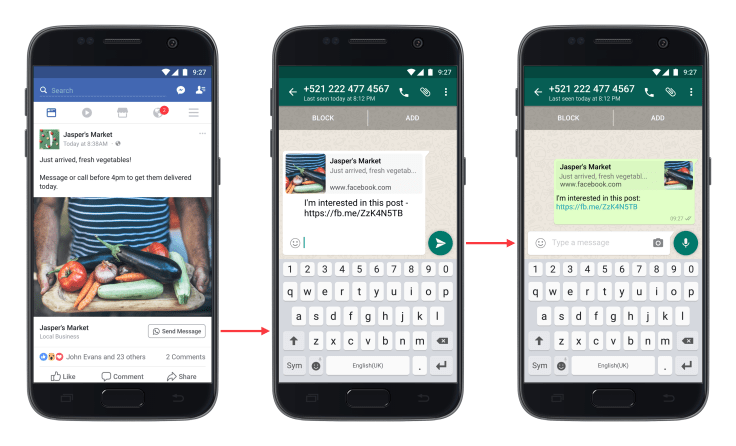
Today, Facebook is launching a new ad unit that will let businesses create a link            between the two platforms: advertisers can now include a button on their ads so that       people can call or message via WhatsApp with the click of a button.

We reported early sightings of the feature in test mode earlier this year.  Now, Facebook has confirmed to us that it’s rolling this out gradually, starting first with North and South America, Africa, Australia and most of Asia.

You might notice that Europe is not included in the list, and wonder if that might relate to news that Facebook last year had to pause efforts to share data between the two platforms when it was deemed to violate data protection laws.
From what we understand, the plan is to introduce Europe at a later date, but Facebook is going to first observe how the feature is used elsewhere, and is also still working through questions from outside the company about how WhatsApp and Facebook will work together.
(Those outside the company may well include consumers, but also regulators.)
The new feature getting announced today, more generally, follows on from some bigger developments for how WhatsApp is already being used by businesses.
Facebook tells us that more than 1 million Facebook Pages already include WhatsApp numbers in their posts each month, which implies that         there is already a pipeline between the two companies being used by businesses more informally to connect with customers more directly.
Anecdotally, I’ve heard that in some developing markets, businesses are using their WhatsApp and Facebook pages as their primary points of contact for users, so this       would make some sense to expand for Facebook, as the new White and Yellow Pages,  respectively.
“Many people already use WhatsApp to communicate with small businesses. It’s a fast, convenient way to stay in touch,” said Pancham Gajjar, product marketing manager, Facebook, in a statement. “By adding a click-to-WhatsApp button to Facebook ads, businesses can now make it even easier for people to learn about their products, set up       an appointment or use their service.”
The other trend to note here is that WhatsApp has been working on a way of creating         more specific business accounts for some time now. Most recently, it’s posted some         more information on its help pages about how business accounts will be verified,      confirmed or unconfirmed — although it has yet to roll out any specific products or         pricing tiers that       speak to these three statuses.
The new button ad-unit is also similar to the click-to-Messenger ads that Facebook previously rolled out.
“That format was the first ad product to explicitly link activity on Facebook with activity           on Messenger, and it was followed by other ad formats on Messenger itself,” said eMarketer principal analyst Debbie Williamson. “It seems that Facebook is following a similar strategy for WhatsApp, starting with click-to-WhatsApp ads on Facebook, and presumably eventually rolling out ads on WhatsApp itself.” (Which really would be a          track back from WhatsApp’s mission statement.)
For now, Facebook does not have plans to add the WhatsApp button integration to             regular consumer services, although you can see the potential for putting the links in,           say, Pages where users want to offer a contact address, or in the Marketplace next to  items that are being sold, or even in job listings.
“We recently started testing different ways for a Facebook Page to point people to their WhatsApp presence from the Page itself,” a spokesperson said, “but don’t have         any more details to share on that right now.”

Litecoin founder Charlie Lee has sold all of his LTC


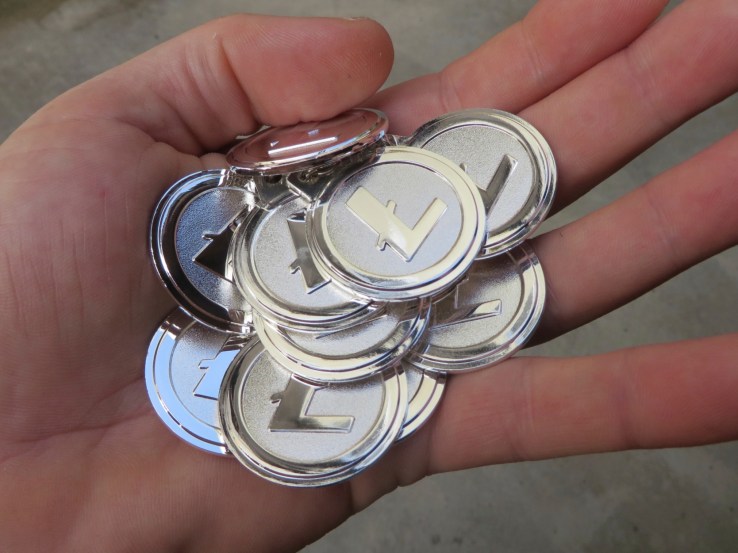
Charlie Lee, the former director of engineering at Coinbase, is selling almost all of his holdings in Litecoin (LTC), the cryptocurrency that he founded in 2011.
Lee explained in a post on Reddit that he is selling all of his LTC coins — bar a number of physical coins he keeps as collectibles — to avoid the conflict of interest that comes with  his influence and position as LTC founder.
Thanks to his time at Coinbase and LTC, Lee is regarded as a key influencer in the       crypto space and he has accumulated more than 378,000 followers on Twitter, where        his handle is @SatoshiLite. While he said he has stayed away from tweeting about LTC prices directly, he acknowledged his tweets have been criticized in some quarters as manipulating the price despite whatever his best interest. Lee readily admits that his  position represented a conflict of interest, hence the unload.
“Whenever I tweet about Litecoin price or even just good or bads news, I get accused of doing it for personal benefit. Some people even think I short LTC! So in a sense, it is conflict of interest for me to hold LTC and tweet about it because I have so much influence. I have always refrained from buying/selling LTC before or after my major tweets, but this is something only I know. And there will always be a doubt on whether any of my actions were to further my own personal wealth above the success of Litecoin and crypto-currency in general,” Lee wrote.
We don’t know how many LTC that Lee held, and had sold, but now he said he is      focused on developing the cryptocurrency itself.
“This is definitely a weird feeling, but also somehow refreshing. Don’t worry. I’m not       quitting Litecoin. I will still spend all my time working on Litecoin. When Litecoin                   succeeds, I will still be rewarded in lots of different ways, just not directly via ownership     of coins. I now believe this is the best way for me to continue to oversee Litecoin’s growth  ,” he added.
Note that Lee’s brother — Bobby — is the founder of China’s largest exchange BTC        China, so this is definitely a powerful crypto family.
Like Bitcoin, Ether and others, Litecoin’s value has grown explosively this year.
It is the world’s fifth larger cryptocurrency, according to Coinmarketcap.com, with a total ‘market cap’ of more than $2 billion. It’s value, at the time of writing, is $330.14 per coin,     up more than 75X from just $4.36 on January 1, 2017.
Trading volumes of the coin have also reached unpre

Wednesday, 6 September 2017

Remember when WhatsApp didn’t want to make money?


WhatsApp is preparing to make           money by facilitating conversations
 between business and consumers           .It’s a great move.Messaging is            huge,  and there isvast scope for            bringing brandsand businesses on board. It’s a process that’s been happeningfor years, predominantly            with Asia-based chat apps that let               users follow official accounts,but enterprising business people in emerging markets long found ways to make use of the hugely              popular WhatsApp service despite no features.Two years ago I wrote that chat apps were             becoming as important as social media forbrands, and that shift has only continued. So it                        is high time WhatsApp got on boardgiven its insane userbase of more than one billion people.             But it wasn’t always that way.
WhatsApp once had a very strict focus on messaging only, with plenty of negative words
 for rival companies who dared to mix business with their chat app product

Tuesday, 5 September 2017

SpaceX runs its Tesla-powered pusher at 220 mph on Hyperloop test track.


Elon Musk apparently felt
 left out when student teams
 competed to achieve top speed
on the SpaceX Hyperloop test
 track last weekend, because
he decided to run the
SpaceX pusher vehicle, which
includes a Tesla drivetrain, down
 the track on its own to
 see how fast it could go.The            Tesla/SpaceX vehicle,which                         works basically like aHyperloop tug boat to propel some of the student pods that don’t                     have their own built-inmotor for acceleration, managed to get up to 220 mph in the sealed             vacuum tunnel,which is faster than the winning student team at 201 mph.

Samsung’s Galaxy Note 8 is a cautious return for the world’s best phablet.

Samsung’s Galaxy Note 8 is a cautious return for the world’s best phablet
Between the explosions, the recalls and its subsequent afterlife as airport PA system fodder, it’s easy to lose sight of the fact that the Galaxy Note 7 was a very good phone. In fact, the line has always been one of the industry’s best and most innovative. It seems it only takes a few well-publicized explosions to tarnish a beloved brand.
But Samsung rebounded quickly. In fact, the company didn’t appear to take any real financial hit from the Note 7 fiasco. It did, however, do its due diligence, investigating the cause of the phone’s battery issues, publicly apologizing and instituting an eight-point safety check in hopes of assuring that it wouldn’t ever repeat its mistakes again. And in spite of some momentary speculation that the company might dump the Note altogether, it was pretty clear to Samsung from the outset that the name it had spent a half-dozen years building up was too valuable to abandon.
Unveiled late last month, the Note 8 is the product of a newly cautious company. It’s easy to see how Samsung’s relentless push to include all the latest bells and whistles might have contributed to its predecessor’s problems. The new Note isn’t a bombardment of new features. Much of what the product brings to the table was borrowed directly from the recently announced Galaxy S8. And most of the rest that’s new seems to largely be an attempt to distinguish the phablet as a more premium option than the similarly sized Galaxy S8+
But that’s not a bad thing, really. The new device is built atop one of the most solid foundations in the smartphone space. And the additions — refinements, really — mostly help to make it that much better.

Tuesday, 29 August 2017

Apple and Accenture teaming up to help enterprises build advanced mobility tools


Apple and Accenture teaming up to help enterprises build advanced mobility tools

There is a general misconception that Apple is strictly about consumer tools, but the fact is that the company has a big presence in the enterprise just by the sheer number of iPhones and iPads in the business world. It also has some high-profile partnerships with hefty enterprise vendors like IBM, SAP and Cisco. Today, Apple announced that it is building on those relationships with a brand new partnership with Accenture, the global consulting firm.
The companies plan to work together to help customers build advanced digital projects on iOS devices. Apple of course brings its iOS expertise to the table. Accenture comes into play because it understands how to connect to legacy backend systems that are lurking inside every large enterprise organization. The company has also long worked with established companies that aretrying to become digital operations. Both of these are targets for the new project.
Ten years after the iPhone debuted, there are more in-house iOS programmers and more mobile development projects than ever before, but companies have struggled to take advantage of iOS to build digital tools to truly transform organizations and how they operate, according to Susan Prescott, VP for apps, markets and services at Apple.
“We’ve seen an increase in development efforts within companies. In fact, in the last three years, the number of in-house iOS developers has doubled,” she said. “So the demand is definitely there, but enterprises still need great partners to reinvent workflows and tap into backend systems.”
She adds, “This partnership with Accenture is about taking that further. What’s really exciting is that this isn’t just about optimizing existing apps and business processes — it’s about designing new apps and experiences using new technologies.”
Apple is looking to work directly with Accenture and enterprise customers to help them dig into enterprise data, and find new workflows that they have never considered before. This isn’t unlike what it has been doing (and continues to do) with IBM, but Apple says it’s going to have a seat at the table with Accenture personnel and share their expertise around iOS to help solve unique enterprise problems — and that is a big difference with this project.
As for Accenture, Gene Reznick, senior managing director for technology ecosystem and ventures for the firm, says they are looking to capitalize on some specific areas with this partnership including helping to create “engaging user experiences.” They hope to improve how organizations interact with customers in a digital way, something that continues to elude many companies. Secondly, they want to make that experience as meaningful as possible by building connections to relevant back-end systems and surfacing helpful data.
While this could take many forms, they see exploiting the burgeoning area of Internet of Things, where they could build iOS applications to help monitor large industrial machines or other complex operations from an iPad or iPhone. They could supplement this idea by building augmented reality applications with Apple’s AR development toolset, ARKit to help with training or repair assistance right on the iOS device.
For starters, the teams will work together in San Francisco, but the hope is that over time, they will expand the project and build additional teams at some subset of the 30 Accenture Studios located throughout the world.

First SpaceX Dragon Capsule is Taking its Final Flight

Last night,   SpaceX launched its first generation Dragon  capsule   on its twentieth and final resupply run to the International Space St...